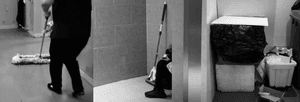
Often employed by subcontractors, the workers who clean office buildings and shopping centres in China rarely have access to rest areas and regular breaks.
At 6.20 am, the corridors of the office building are still half asleep. The overhead lights flicker, as though the building itself is deciding whether it is ready to wake.
Only one sound is certain — the slow, damp drag of a mop across marble.
Fengying Wu has already been working for half an hour.
The 58-year-old moves quietly through the lobby, her orange vest reflected in the glass doors, the fatigue around her eyes forming faint grey crescents. She wipes them with the back of her wrist and walks toward the elevator banks, where the night shift of office workers has already left fingerprints.
"Morning starts with the lobby," she says. "Then the stairs, the floors. One circle after another."
Her voice is soft, almost detached, but her rhythm — its physicality, its repetition — fills the dark lobby like a low hum.

Across the city of Jinan, in other office towers and shopping floors, the same hum begins.
Li Sun has already wiped down a row of restroom cubicles before the first employees begin to arrive, closer to nine.
"Everything is dirty," says the 52-year-old. "The dirtiest work is done by us. I have no education. Everything other people don’t want to do, we do."
The days of these workers stretch eight hours, ten hours, sometimes more. But in these early moments, before coffee machines hiss awake and keyboards begin their staccato chorus, the cleaners shape the city’s morning.
When everyone else arrives, the floors are clean, the bins are empty, and the workers themselves are already part of the background.
A day measured in steps, stairs and silence
By seven o’clock, the buildings begin to fill with faint footsteps and elevator chimes. The cleaners are already on their second or third loop.
The office building has its own scent: traces of disinfectant intermixed with recycled air. The workers move quietly, out of habits honed for years in environments where they are not always wanted.
Fengying walks up stairs, down hallways, around floors, through the rubbish point, back toward the bathrooms and then again.
She doesn’t track her steps, but her colleague does.
"Her phone, through WeChat, can track our steps every day, Sometimes we might walk more than 20,000 in a day," Fengying says. "She is younger than me, but even her legs got swollen."
20,000 steps is the distance of a half-marathon, hidden inside a single building.
Fengying speaks without embellishment, as though describing the weather, yet her hands tell a different story.
When she talks about the walking, the lifting, the hours, her fingers curl slightly, trembling with exhaustion that never fully leaves her.
Last year, her trousers began to fit differently. At first, she thought the fabric was stretching. Then she stepped on a scale.
"I have already lost above ten kilograms since I started this job," she says. "Because of this work. Too tired. We eat less and sleep less. People definitely become weak like this."
Her voice is calm, but the hand holding her thermos trembles.
The body remembers
For Li Sun, fatigue is not a moment. It is not a spike. It is a landscape — vast, unchanging and impossible to avoid.
She wakes before dawn, dresses in near darkness, and steps onto her electric bicycle while most of her neighbours are still asleep. Her 40 minute commute cuts through the city’s industrial outskirts along uneven roads that rattle her wrists.
"From morning to night, it is all hard work," she says. "Hard, dirty, tiring. Every job is tiring."
Her voice is steady but her shoulders sag, as if her body remembers each hour before her words form.
No job near her home pays as much. It’s not that the pay is high, it’s just higher than the near-zero alternatives.

Now Li Sun points to the shiny tiles she’s just cleaned with a combination of pride and resignation. "If I sit here, even for one minute, they’ll say I’m lazy," she says.
Just as she says this, her supervisor walks by. She straightens up immediately. The subtle change is clearly learned behaviour.
This is a workplace with rules about who may be seen and who must remain hidden.
Unpredictable dirt
At exactly 7am, the bus releases a stream of passengers onto the roadside near the office buildings. Fifty-four-year-old Chen Xiuying is among them, and she’s carrying a small backpack and a thermos of cooling tea.
"I have to reach [the office] before the office workers," she says. "The whole lobby needs to be done once before anyone comes."
Her route to work is predictable. Her work itself is not.
Dirt appears unpredictably. Fingerprints reappear seconds after being wiped. Mirrors need to be polished again before her reflection fully settles.
She signs her name on a wall-mounted sheet every hour — elevator buttons, toilet seats, mirrors cleaned. Each signature a record of labour, each pen stroke a small claim to visibility.
"You finish one round, you rest for a moment," she says. "Then you start the next."
But a moment is not rest. It is the thin space between what she just finished and what she must begin again.
Rest is only a word. What it means is something else entirely.
The missing room
When asked about rest spaces, every cleaner gives the same answer: There are none. No break room. No chairs. No place designed for a body to sit.
"We have no rest time," Li Sun says. "When it is really not possible anymore, we hide somewhere for three or five minutes. But not for long."
Can they sit when the manager comes? She lets out a humourless laugh.
"Managers will criticise," she says. "In front of them, you cannot sit."
For the cleaners, rest is not an approved break. It is an act of risk management.

For Xiuying, the closest thing to a rest area is the underside of a concrete staircase. The air here is stagnant and metallic. Pipes snaking above resemble raised ribs. Dust sways in the light of a mobile phone, and the damp has a distinct smell and texture.
"No window. One weak light. Damp. Always damp," she says.
She and several others bring cardboard pieces and small stools. They eat there, breathe there, relieve their backs for a few moments.
"But cannot stay long," she repeats. "If the leader sees, cannot."
Drivers have rest rooms. Security guards have booths. Managers have lounges.
Cleaners have stairwells, electrical closets and corners the public never sees.
The hierarchy is architectural before it is social.
Labour changes the body
Every cleaner remembers when labour changed their body. For Fengying, it was the sudden weight loss.
For Xiuying, it was the day she slipped while wiping glass. "My knee hit the cement," she says. "Hurt for a month. But cannot take leave. No work, no money."
For Jie Li, the shift was psychological. The textile factory where the 49-year-old had worked for almost twenty years closed during the pandemic. In 2023, a cousin suggested she try cleaning work.
On her first day, she was sent to the third floor toilets.
"One stall …" she says, pausing. "Very dirty. I couldn’t get close. Even with a mask.
"It is not that I look down on dirty things," she says.
"It is here." She taps her forehead. "The mind cannot accept it."

Her training was simple: a mop, a pair of gloves and the instruction to "follow the others."
Cleaning is physical work, but it demands the body endure what the mind resists.
Silent hierarchies
Managers rarely raise their voices. They don’t have to.
One lunchtime, Fengying leaned against a foam pad she brought from home. "The manager saw it," she says. "He said it ruined the building’s image. Told me to throw it away."
Once Jie sat on a lobby bench for two minutes.
"The supervisor came immediately," she recalls. "‘You haven’t finished work,’ he said. ‘Why are you sitting?’"
Recently, some cleaners noticed a shift. "Managers speak more politely now," Fengying says. "Because online people are watching. But nothing changed. What we don’t have, still don’t have."
On one floor, management posted a sign: Cleaning Corner.
Below it: a mop, a bucket and cracked tiles.
No chair.
Someone notices
The conditions experienced by these women are not isolated instances. They reflect a broader structural reality shaped by how cleaning labor is organised across much of urban China.
In most office towers and shopping centres, cleaners are not directly employed by the building itself but by outsourced labour agencies. This arrangement often means the responsibility for workers' basic rights — such as rest spaces, working hours, and welfare — is divided between multiple employers.
No one employer is clearly accountable.

In recent years, several widely shared social media posts (above) and news reports have drawn attention to this issue.
One described a cleaner whose only resting space was a small area beneath a staircase, where she placed cardboard and foam to create a makeshift corner to sit and eat.
Similar accounts have appeared in Chinese news outletsand online forums, with images showing cleaners resting in electrical closets, storage rooms, or other spaces never intended for human use.
These stories have resonated with many younger office workers and students, particularly women, who see their own mothers reflected in the cleaners' experiences. On some university campuses and in a handful of office buildings, small informal initiatives have emerged.
Students and employees have written to management, raised small donations, or purchased stools, kettles, and microwaves so cleaners can at least sit and eat indoors.
In a few cases, buildings have designated modest "cleaners' corners", though these are still rare and often temporary.
Yet because these workers are employed through subcontracting agencies rather than by the buildings they clean, access to benefits, paid breaks, or designated rest areas falls into a grey zone of responsibility.
Rest space is not treated as a basic workplace provision but as something optional — something that can be removed without formal consequence.
A sign of change?
Recently more people have shared photos onlineof cleaners they encounter at work. Some say they have only just realised why the last cubicle in public restrooms is often kept locked.
The images have drawn thousands of comments calling for basic rest spaces for building cleaners: a place to sit, access to hot water, electricity outlets and somewhere to eat.
Upon hearing this, Xiuying blinks. "Really? That's true?" she asks. "I’m touched."
But then she falls silent.
"Will it happen? I don't know. I am old. I don't expect to see big changes. But if these things can be achieved, it would be a good thing for those who come after us."
Li is more reserved. "The mall said that perhaps they can set up a resting space for us," she says. "But nothing happened yet. I don’t want to get my hopes up."
Still, something small, almost fragile, has changed.
A customer once said to her, "You’ve worked hard."
"I almost didn’t know how to reply," Li says.
The stairwell after everything else
By evening, the building lights soften. Office workers file out with backpacks and earbuds, walking across polished floors they don’t realise were scrubbed three times that day.
The cleaners begin their final rounds. Another bin. Another smear. Another sink watermark that must be erased.
Some finish at 7pm. Others at 9.30pm. But none go home immediately.
They step into corners: the underside of a staircase, the space behind a pillar, the gap beside an electrical box.
Not to rest. To breathe.
To unbend a spine shaped by 12 hours of folding.
To straighten knees that have climbed thousands of steps.
To let their bodies — unseen all day — exist without being watched.
Their day ends where it began: in a corner no one notices.
A space with no window, no chair, no warmth; the only space given to them.
The only place, in the entire building, where they are allowed to sit.


