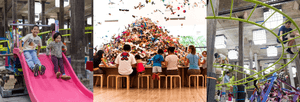
Art institutions are getting rid of the gap between artists and audiences, transforming exhibitions from passive viewing experiences into interactive creative spaces.
For 20 years, Patricia Governor has sold merchandise beside sculptures ringed by Do Not Touch signs. The signs are ubiquitous at the annual Sculpture by the Sea exhibition in Bondi. These small and discrete warnings maintain the fourth wall between art and audience.
This year, one sculpture changed that.
Nyoongar artist Sharyn Egan’s work Rainbow Grass Snake invited visitors to weave sections of the fabric python during the first four days of the exhibition. Gradually these collaborative fragments were assembled into the final artwork, allowing it to grow. Each participant left their mark on the final piece quite literally.

Governor enjoyed watching the audience participation. "This is the first time in my 20 years as a volunteer that an audience has participated in the creation of sculpture," she said.
"People were asking if they could really touch it. They couldn’t believe it."
Egan has often created participatory artworks. During Cottesloe's Sculpture by the Sea in 2024 exhibition, her Balga Boola - Bigsmob Balga changed throughout the exhibition process, as visitors learned traditional Nyoongar weaving skills and created nearly 3,000 branches and leaves on 18 Balga trees.
Rainbow Grass Snake brought this collaborative tradition to Bondi's Sculpture by the Sea for the first time.
It reflects the transformation of contemporary art practice. Artists are shifting their practices and galleries are supporting the work. According to research from UK museum the Tate, participatory art allows the audience to directly engage with the creative process, making them participants in events and transforming spectators into collaborators.
Participatory art emerged from the 1950s Happenings movement. It was sparked when artist and academic Allan Kaprow staged 18 Happenings in 6 Parts in New York in 1959, inviting audiences into the creative process itself. In recent years, the movement has accelerated as institutions seek deeper audience engagement.
Data analyst Mark Glasby has visited Sculpture by the Sea Bondi many times over the last 15 years. He said Egan’s works are completely different from other sculptures.
"[With] Sharyn’s work [you] could see it growing and changing, that gave me a sense of the vitality and creativity of art," he said.
Inside the Tank
Things have gone even further at the Art Gallery of NSW.
Artist Mike Hewson current exhibition’s The Key’s Under the Mat transforms the underground Tank space into an anarchist art park.
Visitors encounter monkey bars wrapped around concrete columns, self-service laundry rooms, swings and well-equipped recording studios. All facilities are built with recycled materials.
After 14 months of preparation, Hewson’s team has invested in safety engineering, structural evaluation and special material research and development.
For example, the soft rubber floor overlays the usual polished concrete, there are signs encouraging visitors to have picnics, and the waterscape installation invites people to play in the water.

In a statement, AGNSW gallery director Maud Page described Hewson as "a disruptor, continually testing the edges of possibility and reimagining the Art Gallery as a site where boundaries dissolve and where art can unfold in ways once thought impossible in an art museum." Hewson describes his role as a host who sets the stage for others to use the artwork as their own.
"Everything of this space announces that the regular rules no longer apply," said Debra Frances, a regular visitor to the gallery.
"People have picnics on the floor, children climb between devices, and people really live in art.
"It completely subverts the idea that the art gallery is a quiet and forbidden space."
Stanislav Popelka and Jiri Vyslouzil’s recent research on museum visitor engagement confirms this transformation. Data shows interactive exhibits attract more attention than static displays, and visitors spend 47 per cent more time in front of participatory exhibits than traditional exhibits.
And the public’s expectations of cultural participation are changing. Exhibition attendee Susan Lubbers believes said participatory art is challenging the long-standing elitism of Australian cultural institutions.
"Art has long been an object for people to see from afar, which belongs to the exclusive domain of experts and connoisseurs," Lubbers said.
"When you are invited to contribute your creativity, and when your hands are really involved in the shaping of the work, this hierarchy is broken and art becomes within reach.
"We are no longer just an audience, but a co-creator."
A collective canvas
Brisbane’s Gallery of Modern Art (QAGOMA) maximised participation through last year's Wonderstruck exhibition, which presented more than 100 works of art and interactive projects by more than 70 artists.
Co-curators Tamsin Cull, QAGOMA’s Head of Public Engagement, and Laura Mudge, Senior Program Officer for the Children’s Art Centre, designed the exhibition specifically to encourage the audience to engage with works from multiple angles and participate in their experience of the works.
One of the most eye-catching works was Isabel Aquilizan and Alfredo Aquilizan’s In flight (Project: Another Country), which invited participants to make airplanes with found materials. These included recycled items, corner materials and twine.
The creations evolve with the participation of each visitor. Some people create patterns, and some people decorate them at will.
And when the exhibition closed, this extraordinary collective work of art was made up of thousands of individual creative choices.
Why now?
The timing of this transformation comes down to many different factors.
Land developer Alan O’Reilly, a visitor to the Sculpture by the Sea exhibition, said he believes years of social media engagement have made audiences look forward to something more interactive.
"People are eager to participate and be a part of the story," he said. "It can be seen from the way they shoot [photograph] sculptures and the way they put themselves in the artwork.
"The Instagram generation is not satisfied with just viewing, they are eager to participate and share the process."
The popularity of the Wonderstruck exhibition and Hewson’s Tank project show that audiences want to participate.
"In the past, artists often worried about losing control and fearing that the audience would tarnish the artistic vision," Lubbers said.
"But [Sharyn] Egan’s work proves that when you truly trust the public and give appropriate space for participation, people will treat art with unimaginable respect, and create beauty that you have never expected."
Governor is looking forward to the next Sculpture by the Sea Bondi, and she's curious to see whether Egan’s collaboration will inspire other artists.
"Once seeing the possibility of audience participation, it is difficult to return to the simple viewing mode," she said.
"Those 'don’t touch' signs may become relics of another era."

