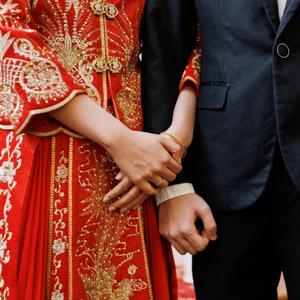
Bride price expectations in rural China continue to shape young women’s futures. While rising payments, economic pressures and gender imbalance limit their options, change remains slow.
The piles of cash on the floor are taller than the bride herself. In the wedding photos, her smile looks stiff amid the blur of red envelopes, gold bracelets and camera flashes. In the village square, neighbours whisper the amount like an achievement.
But no one ever asked what the bride wanted; instead, the money spoke for her.
In recent years, China’s marriage rate has fallen sharply, hitting its lowest level in decades. According to official statistics, around six million couples registered their marriages in 2024, a 20 per cent drop from 2023. It's also less than half the number recorded in 2013, when about 13.5 million marriages were registered. It shows the broader demographic shifts and economic pressures facing young people in China.
Yet in many rural regions, the custom of paying a bride price remains strong and the image of a bride surrounded by red envelopes is a familiar one.
And despite the rapid rate of national development, these young Chinese women are still navigating a future shaped by the expectations of family, economy and tradition, rather than their own choices.
When a daughter comes with a price
The tradition of bride price, known as caili, was once a symbolic gift between families. In older generations, it might have been tea, fabric or jewellery — something small to express sincerity.
It is usually negotiated and paid by the groom’s family to the bride’s family before the marriage, during the engagement stage rather than at the point of legal registration.
But over the last two decades, the meaning has shifted. Today, caili is often treated as the cost of marriage itself, a financial threshold that must be met before a marriage can proceed. In some provinces, payment amounts can reach hundreds of thousands of Chinese yuan. And families often add gold, furniture, appliances and sometimes a down payment for a house.
The cash component is often transferred directly to the bride’s parents, while non-cash contributions such as housing may later be shared by the couple.

Historically, bride price was seen as compensation for the bride’s family for the loss of her labour, while more recently it’s become a form of endowment for the couple.
But for households with limited income, the daughter’s marriage may represent a rare moment of financial return.
Girls from rural areas are more likely to leave school due to financial or marital pressure than those living in urban areas. The demographic imbalance — the number of young men compared to women due to China’s historical one-child policy — intensifies this pressure. As more young women migrate to cities for education and work, many rural regions are left with plenty of marriage-aged men, increasing competition between families and driving bride prices even higher.
The classmate whose future ended early
Growing up in Shandong province, I saw that marriage stories were often measured in numbers, not feelings. The question, often asked by neighbours and relatives when an engagement was announced, wasn’t "Do they love each other?" but "How much did the groom offer?"
A high bride price was praised, even celebrated, as proof a girl had worth.
Among the stories shared in my town, there was one that epitomised this: Li Xinyu, a classmate I once admired, was bright — especially in biology — and she used to linger after school to finish her notes. She told anyone who asked that she wanted to study medicine in Beijing.
But in her final year of middle school, she stopped coming to class. Teachers said only "Family matters" when we asked after her. For months, her desk sat empty.
Later, we heard the familiar explanation: her parents had arranged her marriage. The bride price — 380,000 yuan (about AU$70,000)— was considered respectable for our area. To her family, it meant security. To her, it meant the end of a future she once imagined.
Stories like hers circulated often enough that no one questioned them. They were simply treated as the rhythm of rural life: a daughter grows up, a bride price is negotiated and a marriage is arranged. Whether she wanted that path was a quieter part of the story, something rarely spoken aloud.
I never learned what happened to Li Xinyu; like many girls in similar situations, she quietly disappeared from the stories people told.
Numbers reveal what girls can’t say
Rural gender studies have noted that when marriage is treated as a transaction, it narrows what young women are allowed to want. In rural development studies, researchers highlight how economic pressure reinforces old gender norms: daughters are still expected to marry out and their value becomes linked to the amount of money exchanged for that marriage.
Once women are in these marriages, the bride price can still play a role in her life.
While no national statistics track poverty, mental health or domestic violence specifically tied to bride-price marriages, sociological research suggests that transactional marriage practices often coincide with reduced autonomy for women, lower educational outcomes and increased dependency within households.
Research in rural China shows that such financial exchanges shape gender roles and can contribute to economic and social pressures on women well after marriage.
Studies have also shown that divorce rates are low for those who had a high bride price, as it’s unlikely their family will be able to pay it back. So these women may feel trapped in their marriages.

Young men also feel pressure around bride prices. When they and their family cannot afford high bride prices, they may delay or forgo marriage in what some analysts describe as a "marriage squeeze".
Families in rural areas sometimes incur significant debt to meet social expectations, taking on loans or selling assets, which can create long-term financial strain and uncertainty for household sustainability.
Consequently, local governments are pushing back on high bride prices. In 2023, the Jiangxi Provincial Government launched a campaign to curb high bride prices, promoting simpler weddings and issuing guidelines to discourage extravagant payments. From 2022 to 2023, Henan province rolled out a similar initiative as part of its rural revitalisation plan.
These policies reflect a growing recognition that bride-price inflation is not merely cultural — it is an economic and social issue affecting mobility, education and gender equality.
Yet policy can only reach so far. Change is slow in communities where expectations are woven through generations, and where a daughter’s so-called value is still publicly negotiated.
Loud online, quiet in real life
Online platforms, especially RedNote, show a very different mood. The hashtag #RejectHighBridePrice has drawn millions of views, filled with young couples sharing modest weddings, refusing heavy payments or questioning why love must be proven with money.
One widely shared post from a user in Henan province, China, read "We just wanted to prove that love doesn’t need a receipt."

This comment was made in response to discussions about high bride prices on Chinese social media.
But online energy doesn’t always translate offline. Many rural families continue to believe that a high bride price offers protection. It's seen as evidence their daughter will be valued or at least financially secure.
Others feel bound by community expectations: if everyone else demands a high price, lowering it feels like admitting their daughter is worth less.
Fighting for her future
When I think of Xinyu, I remember her handwriting in the margins of her textbooks. I remember her telling me she wanted a white coat, not a wedding dress.
Her story stays with me because it is both personal and universal: this was a girl I knew and a pattern repeated, with her dreams constrained by forces beyond her control.
Tradition can be meaningful. But tradition should not decide a girl’s worth before she can speak for herself.
Change may arrive slowly, but it begins with a simple idea: A woman’s life is not a transaction. Her future should belong to her.
