

Supermarket shelves are full of protein-boosted products while fitness influencers spruik the benefits of increased protein intake. But how much protein do most people really need?
Tully Agostino-Morrow remembers what it’s like to be desperate for any boost in the gym.
“When I was 16 or 17… I was trying to get massive in the gym like a lot of blokes [that age],” says the 20 year old.
“It feels like if you can go to the gym as much as you want and train as hard as you want, but if you’re not hitting your protein [targets], then it’s training for nothing.”
This focus on increased protein intake is all over social media. Professional bodybuilders and fitness influencers like Jeff Seid, Mike O’Hearn and Kai Shephard often post info on how much protein is needed.
 Mike O'Hearn (L), Kai Shephard (C) and Jeff Seid (R) have a combined 9.6M followers on Instagram alone. @MikeOHearnTitan (YouTube), @kaisheps (Instagram), @officialjeffseid (Facebook)
These accounts are followed by millions of young people, predominantly young men.
“Every 17-year-old kid worships them,” says Tully of these influencers. “You can’t follow that lifestyle, but you don’t know that.”
How much protein is needed?
The Australian government ‘Eat For Health’ guidelines specifies a recommended daily intake of 0.84g/kg for men aged 19-30 and 0.75g/kg for women the same age, or an average of 64g and 46g respectively.
This is the healthy level for those participating in an average level of exercise – 2.5 to 5 hours of moderate exercise per week – and with no underlying health conditions.
But that’s different to what appears on social media.
Several prominent Instagram accounts claim that 1.2 to 1.6g of protein is needed per kg of body weight for general muscle maintenance.
A Men’s Health UK article points to research suggesting that 1.6-2.2g/kg is needed to “grow at the maximum weight”. The same article also mentions that elite, professional athletes eat “around 2g per kg every day.”
Tully wanted to be more muscular so he started trying to reach these numbers. “I was looking at 1.5 to 2 [grams per kilo of body weight],” he says.
But these protein figures are problematic.
“The vast majority of Australians do meet their protein requirements,” says Dr Eden Barrett, a senior research fellow at the George Institute, specialising in public health nutrition.
“[Particularly if you] follow a Western diet.”
Dietitians Australia only highlights a select group of people, including children, the elderly and those recovering from illness, who need to increase their protein intake. Vegans and vegetarians can also find it challenging to get enough complete protein.
While protein demand can increase through further exercise, its influence is overstated, Dr Barrett says.
“More protein is not going to make you build more muscle,” she says.
“You need strength training to do that. Strength training and enough in protein and enough in calories.”
Importance of a diverse diet
“You need a good source of protein and a good source of carbohydrates, but that can come from food like a meal after [a workout],” Dr Barrett says.
She says there are more important nutrients that need to be considered for fitness goals.
“Protein’s not something we have that Australians aren’t taking enough of,” she says.
“But things like fruit and vegetables are … There’s a risk that those areas that actually do need more focus will be neglected even further.”
 Dr Eden Barrett says while protein is important, there are other areas of health that need to be prioritised.Supplied
Exercise science student and pescatarian Lilly Spring also focuses on having a diverse diet.
“As a pescatarian, you have to be quite conscious of [meal planning],” she says.
“So most of [my protein] does come from whole foods, so like fish, eggs, legumes, tofu.
“I go by the general rule that you’re supposed to get as much as you can from whole foods and only use supplements if they’re required.”
While protein supplements can be useful for conveniently and quickly boosting your protein, an over-reliance on these supplements is something to be wary of, says Dr Barrett.
“Whole foods contain a variety of different nutrients… and if we aren't taking enough of those foods, then we won't get enough of those,” she says. “There is a lot of evidence coming out now that shows that diets that are high in processed foods are associated with health harms.”
That includes protein-enhanced foods, including bars, cereals and even cheeses, which could all be classed as ultra-processed foods.
Deciphering labels
“In Australia, you can make claims about nutrient content [in a product] and… the product has to have that amount of nutrient in it, but it can otherwise have a pretty unhealthy profile,” says Dr Barrett.
For instance, a 60g Famous Nutrition protein bar contains 20g of protein but also 11.2g of sugar.
That’s 0.9g less than a Krispy Kreme Donut.
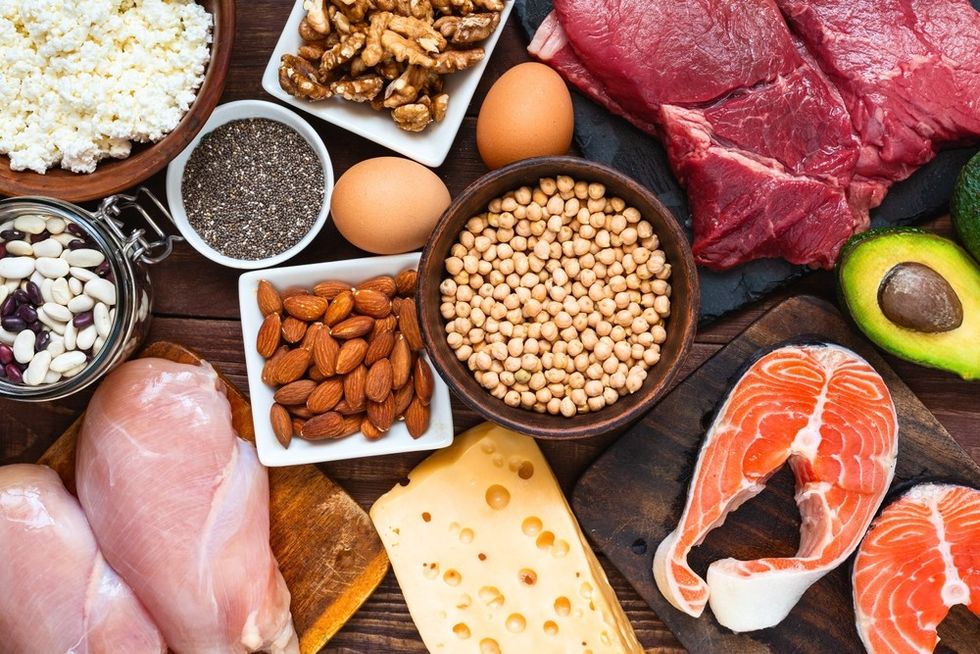 Ideally protein should come from whole foods Shutterstock
And there are unusual ways of advertising the health aspects of a product.
A product only needs 5g of protein to be labelled as a protein source, according to research from UNSW nutrition lecturer Emma Becket.
This can lead to strange interpretations of this rule. For example, Babybel cheese has a black-wrapped Protein variety with 5g of protein per serving, while regular Babybel cheese has 4.6g of protein per serving.
Increased costs
Protein bars, powders and supplements can be costly and most protein-enhanced products have higher costs than the regular versions.
When Toby McErlane was training for competitive swimming, he felt those increased costs on a uni student budget.
“[My roommate and I] were absolutely ‘min-maxing’ every dollar for every gram of protein and energy we could get,” he says.
“Protein powder, I feel like I can justify the cost. But protein bars, I can’t justify that cost.”
He uses protein powder as a "safety net" of protein, but he waits until a sale to buy it. “I just focus on what’s more affordable,” he says.
So what's the solution?
The average Australian is unlikely to suffer damage from eating too protein, apart from to their wallet.
Harvard Health recommends non-elite athletes and bodybuilders keep under 2g/kg of protein per day, meaning that those sceptical of government guidelines can stay around the 1.2-1.6g/kg range if they want.
Dr Barrett stresses the importance of a balanced diet, as well as increasing awareness of reputable sources within social media.
“I think part of [a solution] is joining that space and having as many qualified experts talking on those platforms,” she says.
And Tully is now more relaxed about his protein intake.
“I think I’ve wanted to get more informed,” he says. “If I can get a general ‘I know this food has got a good amount of protein in it’, that’s more where I sit.
“I don’t count the grams. The effort’s not worth it.”