

These three friends made a startling discovery while looking at the night sky. Now they've been published in Nature journal and awarded the Page Medal.
When Jonathan Bradshaw was young, he’d spend hours staring at the night sky.
"I was just one of those kids that found comfort looking up at the stars at night," the Coffs Harbour man said.
Little did he know that years later, his hobby would be officially recognised by the Astronomical Society of Australia (ASA).
In April, the amateur astronomer and fellow stargazers Renato Langersek and John Broughton were awarded the Berenice and Arthur Page Medal for their part in a significant astronomical discovery.
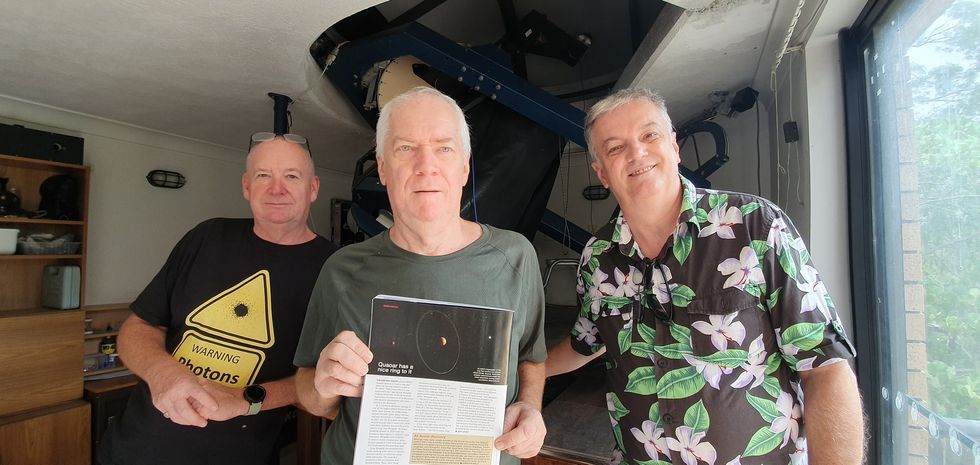 Bradshaw, Broughton and Langersek's (left to right) discovery was reported in a Nature paper published February 2023. (Supplied: ASA)
In August 2021, Bradshaw was one of several amateur astronomers observing the occultation of Quaoar, a dwarf planet in the Kuiper Belt beyond Neptune, when he spotted a "blip" through his telescope.
An occultation occurs when one planetary body passes in front of another. This makes the first body visible against the light of the second.
"It’s like a solar eclipse, only on a miniscule scale," Bradshaw explained.
"I was chatting to Renato [Langersek] at the time on Messenger," Bradshaw said. "[I asked him] ‘Did you see that blip?’ So we have to wait for half an hour for the whole data capture process to finish. [We] go back, and he’s got this little blip roughly similarly timed too. And then John Broughton down the road, he had one too. And we lined them up."
The blip the trio spotted was a ring system, similar to those revolving around Saturn, Jupiter, Uranus and Neptune. Ring systems are usually made up of debris like dust particles and chunks of rock and ice.
But something was wrong with the ring around Quaoar.
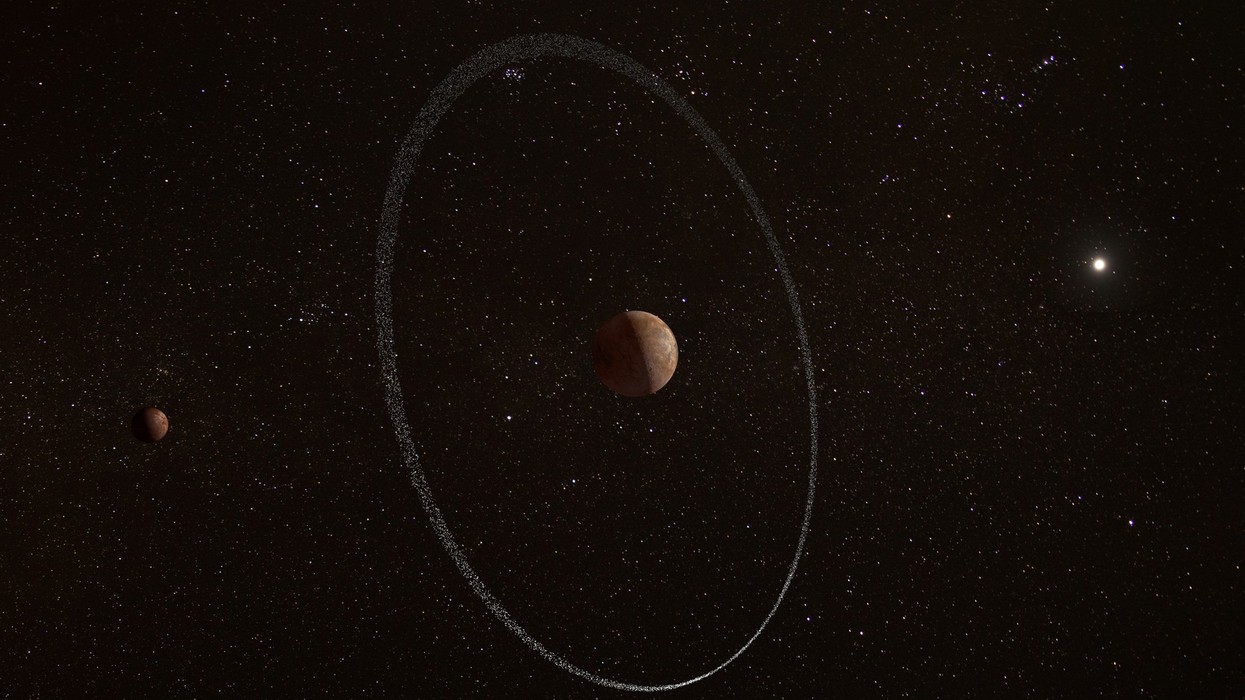 Quaoar is an icy dwarf planet in the Kuiper belt beyond Neptune with rings revolving 4,000km above its surface. (Supplied: ASA)
It was rotating roughly 4,000km above the planet’s surface — beyond the limit where ring systems usually form.
"It’s literally twice as far away from the planet than it should be," Bradshaw said.
The trio’s discovery of a ring system that defied the theories of the time drew significant interest from the scientific community.
"We didn’t quite break gravity," Bradshaw laughed.
"But it’s just one of those rule-of-thumb theories which is now being demonstrated to be at least incorrect in one case."
The discovery was reported in a Nature paper published in 2023, which Bradshaw, Langersek and Broughton co-authored.
Bradshaw said the discovery wouldn’t have been possible without his fellow amateur astronomers. He jokes that occultation is a "team sport played alone", in that he watches the occultations by himself but cross-references his findings with those of others for accurate results.
"The more observations you get, the higher the quality of the data," Bradshaw said.
Quaoar and its ring system will be visible from Australia’s east coast on May 16. While Bradshaw expects plenty of astronomy enthusiasts to turn out, he suspects the visibility of the ring will be limited. So he’s hoping professionals get involved.
"The star itself was about the brightness of the dwarf planet Pluto, so it’s really, really faint," he explained.
"So we’re hoping to get the word out of it and see if we can get some of those professionals who’ve got bigger toys than us."
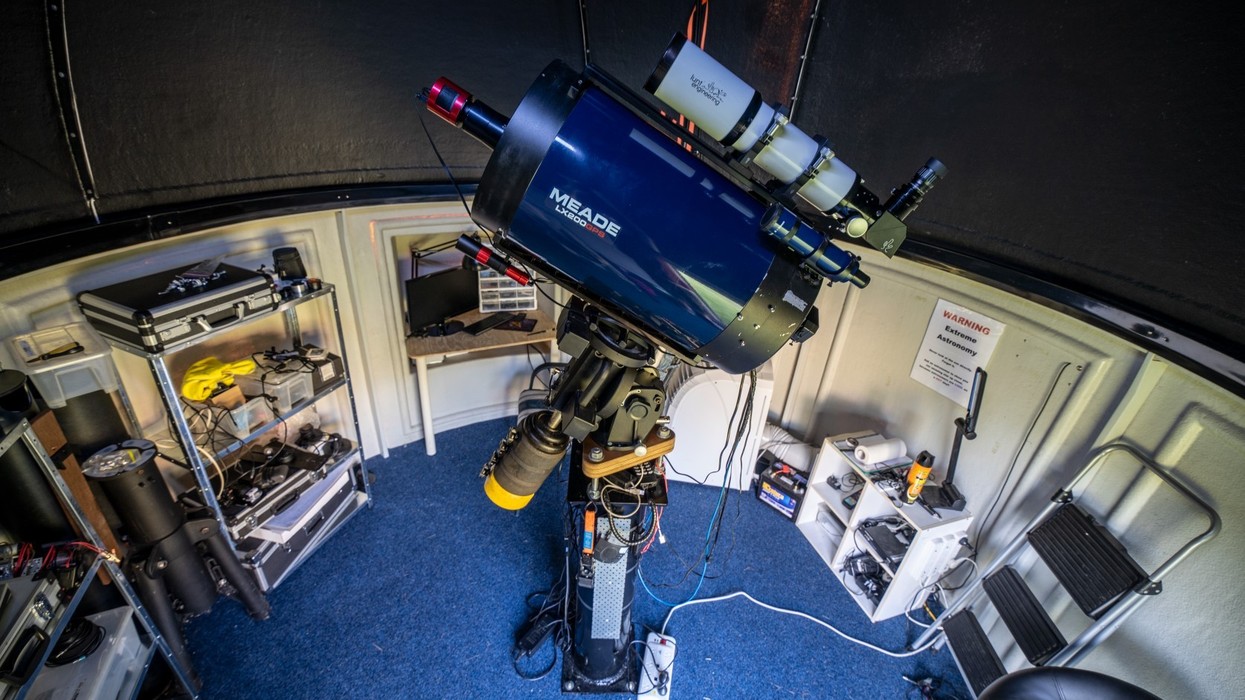 Astronomy equipment like Bradshaw's telescope (pictured) is affordable and accessible for enthusiasts. (Supplied: Jonathan Bradshaw)
Bradshaw, who currently serves as president of the Coffs Harbour Astronomical Society, has always been involved in astronomy.
Raised in Newcastle upon Tyne in England, he remembers when Neil Armstrong became the first person to walk and talk on the moon in 1969.
"I was standing behind the sofa at X o’clock in the morning listening to Neil Armstrong land on the moon as a toddler," he laughed.
His interest in the scientific side of astronomy blossomed when he migrated to Australia in 2004, and got a good look at our starry night sky.
"The core of the Milky Way, where the vast majority of stars in the Milky Way reside, it’s looking towards the core of our galaxy," Bradshaw explained.
"So it happens that if you stand in Australia, but particularly northern New South Wales [or] southern Queensland, [in the] middle of winter, directly overhead is that body of stars. So it could not be better placed.
"There’s no better place on Earth to observe astronomy."
Australia’s night sky inspired Bradshaw to purchase a telescope of his own, and his journey as an amateur astronomer began.
"There [was] a news article about some sort of aging bloke with a big telescope who’s measured the atmosphere around Pluto. And I’m going, I want to be an aging bloke who measures stuff," he laughed.
Bradshaw met Broughton on his very first occultation in the mid noughties.
"John Broughton’s a brilliant bloke," he said. "He’s Australia’s most prolific discoverer of asteroids and comets. He built his own walloping great telescope into the fabric of his house."
Broughton was awarded the Page Medal in 2008 for discovering more than 500 asteroids and two comets.
Bradshaw met Langersek, who is an active member of the South East Queensland Astronomical Society, at the Queensland Astrofest. "We’ve been good mates for a long time," he said.
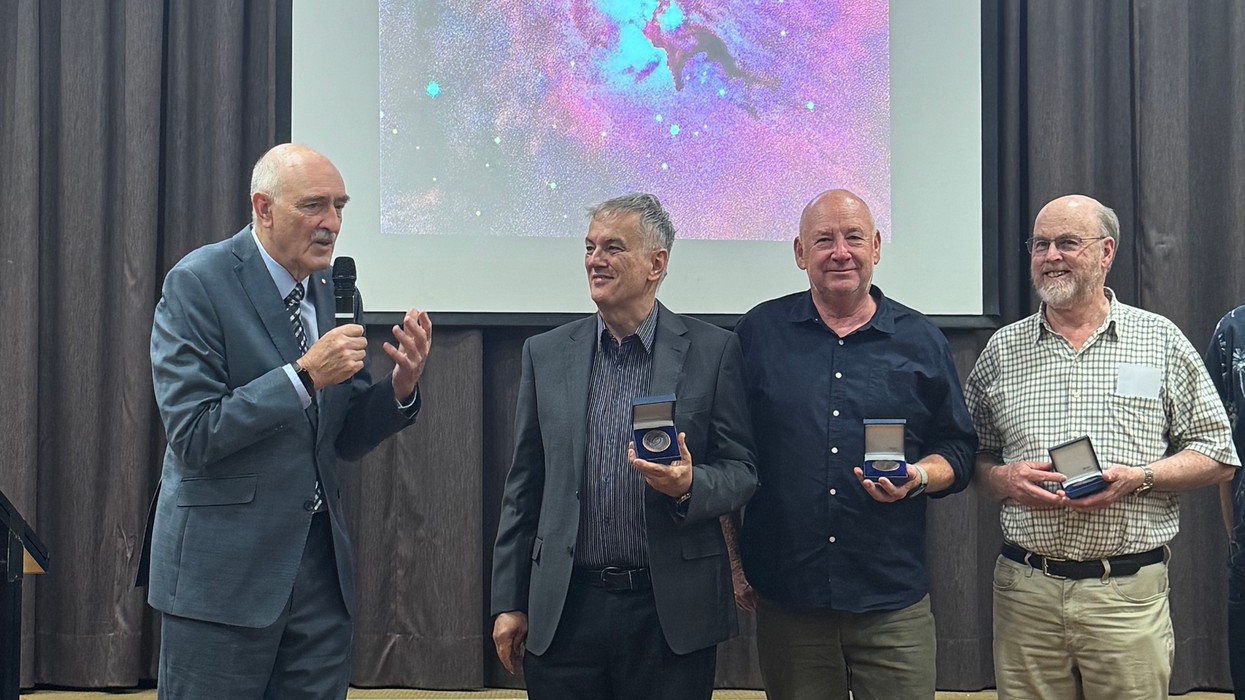 Langersek, Bradshaw and Chris Stockdale (middle-left to right) were awarded the Page Medal by renowned astronomer Dr Fred Watson. (Supplied: ASA)
Bradshaw, Broughton and Langersek were invited to an occultation event in the Northern Territory in June 2022 by NASA. Langersek also attended events in Mexico and the USA.
"Oh, look, it is special," Bradshaw said of the opportunity to work with professional astronomers. "It’s good to be involved. Being involved with the professional community is just fun.
"If you get involved, if you’re active, then you get more opportunities as a consequence."
Fellow Page Medal recipient Chris Stockdale has an astronomy setup estimated to be worth around $100,000, but Bradshaw insisted that astronomy isn’t an expensive hobby.
"Chris’ work is photometry, and photometry is very, very precise," he explained. "Occultation work is much less precise.
"The telescopes that we used to do that [occultation] with NASA - you’ve got a $2,000 camera and you’ve got a $4,000 telescope that you could just buy from your local shop.
"It’s very accessible, quite honestly. It really is."
Being an amateur astronomer gives you freedom to explore whatever you want, Bradshaw said. "The professional community, their research is highly targeted," he said. "Whereas amateurs, we can do anything we want.
"The trick really is to find something that piques your interest, and then work out how you’re going to get involved in it."
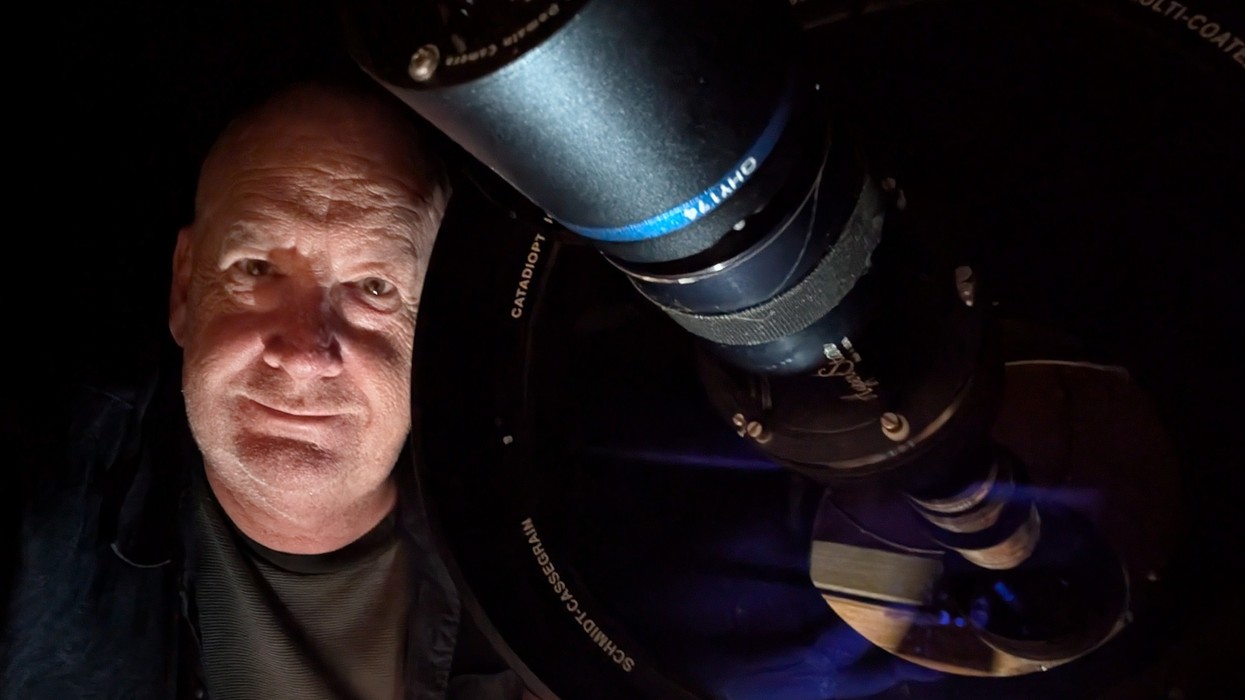 Bradshaw was previously president of the Astronomical Association of Queensland, and now serves as president of the Coffs Harbour Astronomical Society. (Supplied: ASA)
ASA prizes coordinator Dr Tanya Hill agrees. "These ‘backyard astronomers’ remind us that everyone can look at the night sky and observe," she said while presenting the trio with the Page Medal. "And their observations can guide the work of billion-dollar telescopes."
And if Bradshaw, Broughton and Langersek’s story is anything to go by, then getting involved in amateur astronomy might offer up more than expected.
 Podcast: Godfather of solar predicts future of energy