


The internet is often inaccessible to blind and visually impaired people. This could change with emerging AI technology.
With a tap of a keyboard, swipe of a screen and click of a link, the internet enables billions of people to browse almost 200 million active sites. But for those like Martin Stewart, who are blind or visually impaired, it’s not always easy.
The 62-year-old was born blind and uses an iPhone with its built-in screen reader feature to navigate the digital world. All websites should be accessible to allow the screen reader to filter through elements such as text, images and links, but this isn't always the case.
“The majority of websites are not accessible,” Stewart says.
Millions of accessibility errors
According to a 2025 report by Web Accessibility in Mind (WebAIM), almost 95 per cent of sites home pages failed to comply with online accessibility guidelines. Across one million pages tested, WebAIM found almost 51 million accessibility errors. These errors include low contrast text, missing image descriptions, and empty links or buttons.
 Martin Stewart was born blind and uses a screen reader to access the internet.Supplied
“It's just a general headache that we have when it comes to a pandemic of inaccessibility," Stewart says.
“The internet was designed for people that don't have disabilities.”
He describes feeling “devalued”, “frustrated” and “not thought of as a member of society” when he experiences online inaccessibility.
To combat these access barriers, Stewart uses artificial intelligence tools to navigate the web. He uses AI software such as ChatGPT, Copilot and Innosearch.
“In the last two years, AI technology has opened a lot of information and abilities that [blind and visually impaired people] were not able to [use] before. So our capacity is ever increasing due to AI,” he says.
“It's just been a tremendous revolution. It's the only way I can describe it.”
And there's more to come, because AI technology can help to improve the inherent inaccessibility of the internet.
How AI helps
Software engineer and University of Technology Sydney graduate Marcel Qayoom-Taylor recently led a team of developers to create Guidedog, a tool to correct accessibility errors in code.
“Web accessibility in the current state of the developer world is a nice-to-have,” Qayoom-Taylor says.
“It's something people don't really think about, unless they're really trying to follow best practices.”
The inspiration for the program came from Qayoom-Taylor’s own experience deprioritising accessibility in his code.
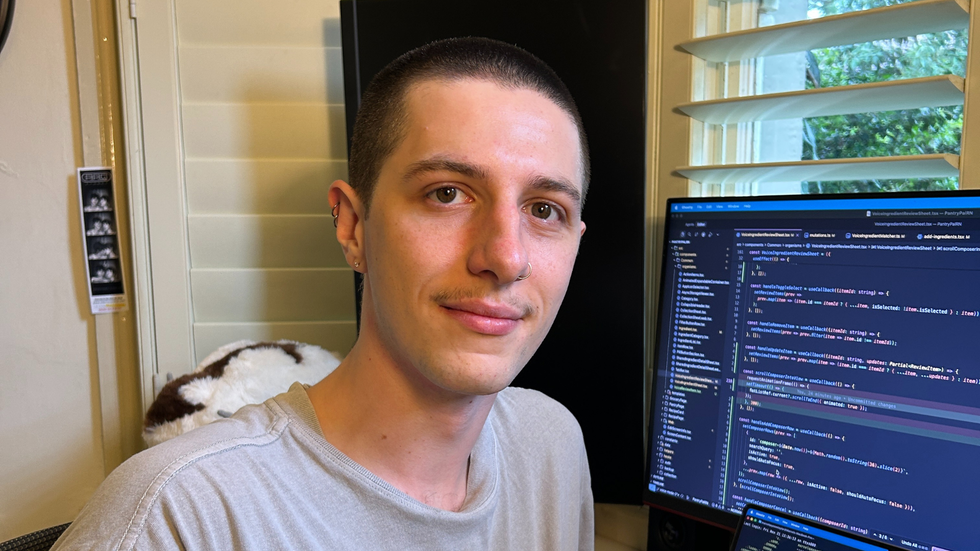 Marcel Qayoom-Taylor is a software engineer with experience in web accessibility. Supplied
“As someone who does a lot of web and mobile development, I've fallen into the bracket of not putting accessibility front of mind due to not having the time to do it," he says.
“It felt like, with the rise of smarter AI, and especially in the world of developer tools and how integrated it is, it was just the puzzle pieces fell together in terms of a need and a new tool that could have been paired together perfectly.”
Another AI-powered technology with potential to increase online accessibility is agentic browsing.
Agentic browsers allow AI to take control of an internet browser and perform actions such as shopping, scheduling appointments, and filling out forms.
2025 was the “year of agentic AI”, according to IBM. And with new developments, agentic browsing could change the way disabled people access the internet, bypassing online inaccessibility. The implementation of agentic browsers also has the potential to reshape the accessibility of existing websites.
Agentic AI functions by filtering through elements on a website, much like screen readers. Multiple guidelines have been released on how to make websites more “AI agent friendly”. Many of the tips in these guidelines mirror the Web Content Accessibility Guidelines, an internationally recognised digital accessibility standard, including adding alternative text and labelling website elements.
By making a website friendlier for AI agents, accessibility and functionality for screen readers are also improved.
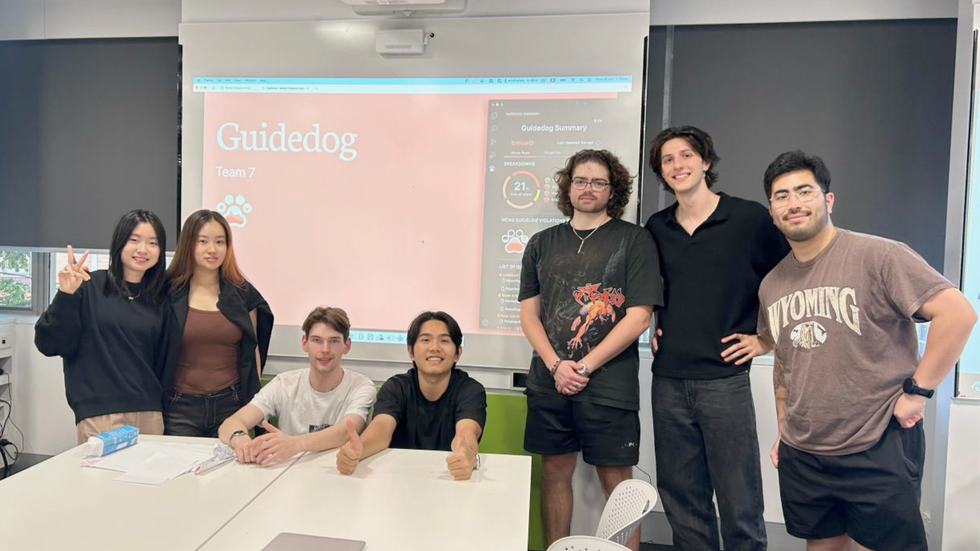 The team of University of Technology Sydney students Qayoom-Taylor led to create Guidedog.Supplied
How AI hinders
Yet while accidental accessibility appears to be a positive side effect of agentic browsing, Qayoom-Taylor worries it could disappear if new ways of training AI agents emerge.
“People might rely on [accidental accessibility] as a nice reason or a nice marketing thing to do when in fact, if there's another way of giving agents better insight into the web, then they'll just pursue that and drop their accessibility benefits,” he said.
“If a change comes out that accidentally undoes some accessibility feature that was previously there, I would say 99 per cent of projects wouldn't know.”
The regression of online accessibility is something Stewart is familiar with.
“[Blind and visually impaired people will] often come across an accessible app but wonder whether it's deliberately that way or whether it's been a good accident, and hope they don't update it and break all this accessibility that they may not have intended to create for us.
“If they don't know that they've actually done it, they won't be mindful enough to keep it,” Stewart says.
“So often, completely accessible apps with one update become the opposite.”
Despite this issue, Stewart is hopeful that the future of AI will remove online inaccessibility.
“If AI is truly intelligent, insightful and all the other things they tell us it will be, it will be naturally inclusive itself, because it's intelligent enough to be,” he says.
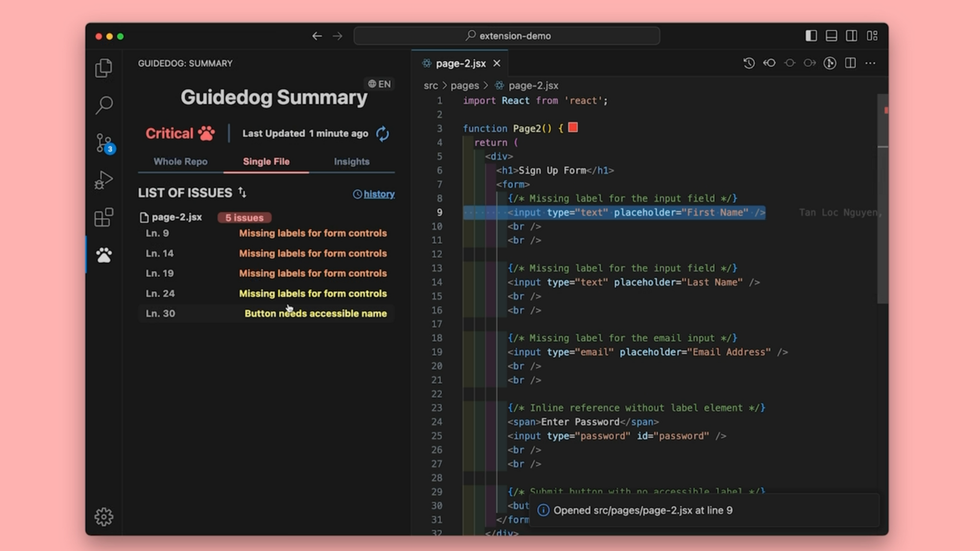 Guidedog is a Visual Studio Code extension to flag accessibility errors in code.Supplied
But Qayoom-Taylor is not convinced. Since artificial intelligence trains on existing material, any biases present can persist. This includes inaccessibility of websites.
“AI is trained on a lot of public code, and most programmers are not very good at coding. There's also great coders who aren't following great practices,” Qayoom-Taylor says.
“A lot of websites and apps don't intentionally put the effort in to make them highly accessible. So when that's the norm right now, that translates directly into these AI agents that are suggesting what code to write.
“If I pull up ChatGPT right now and I say, ‘make me a website’, I can almost guarantee that there’s a 90 per cent chance it's not going to add any or [have] minimal accessibility features.”
While AI still has some way to go before eliminating online inaccessibility, the potential of AI to help disabled people access digital spaces is bittersweet to Stewart.
“I'm 62. I wish I could live another 70 years because I think in the next stage of my life, I'll be getting excited [about AI], but then I won't be living long enough to enjoy it all.
“So part of it is a bit frustrating, but I'm excited by the present day just being around, being here at a time where the revolution has begun.”