

The ACCC reports losses through scams have recently increased by 26 per cent, as experts say artificial intelligence is increasing the risk of online fraud
When second-year student Leyan Ping opened her mailbox one afternoon last January, she was horrified by an email's subject line.
It read "Tuition fee outstanding".
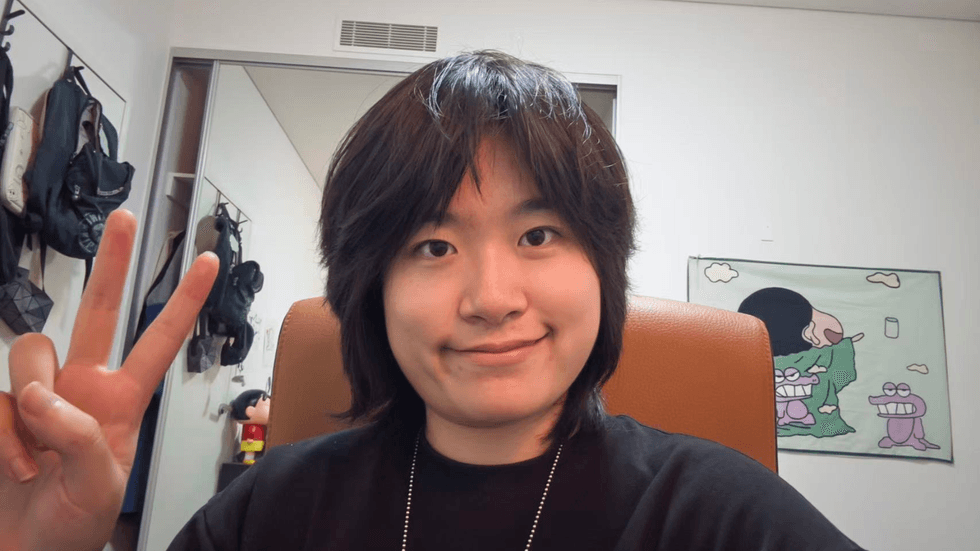 Student Leyan Ping received a cloned tuition fee email that imitated her university’s official layout. Source: Yifei Wang
"It looked very real," she says. "With the same logo and layout as the school emails."
The message stated that she owed the university $1,550 and it warned that her case would be sent to the legal department if she didn’t pay.
"I was very nervous," Leyan recalls. "I thought maybe I forgot to pay something, I almost clicked the link."
But something felt strange and she did further checks. "I checked my bank first and saw everything was fine," she says.
"Then I looked at the email more carefully. I noticed the file name said USNW, not UNSW. When I checked the sender’s address, it ended with .store instead of .edu.au That’s when I knew it was a scam."
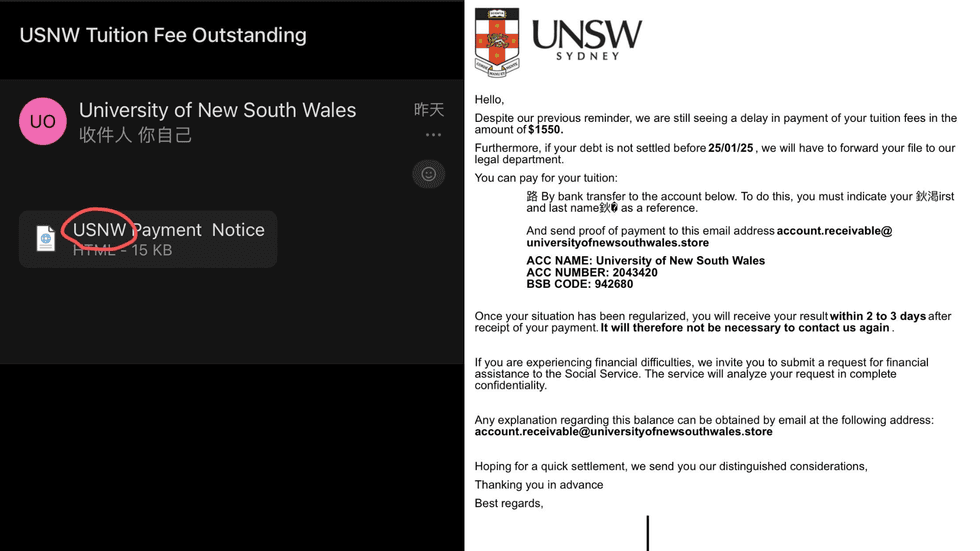 While the cloned scam email looks official, spelling mistakes and a suspicious sender email address raised red flags. Source: Yifei Wang
Later she reported the scam to the university's IT support and posted a screenshot online to warn others.
"It looked so professional," she says. "If I had been in a hurry, I might have transferred the money."
According to the Australian Competition and Consumer Commission (ACCC), Australians lost about $173.8 million in scams in the first half of 2025. The reported losses increased by 26 per cent compared with the same period in 2024, even though the overall number of reports has declined.
The National Anti-Scam Centre has warned that criminals are increasingly using new technologies to forge legitimacy, while scams are becoming more complex and hard for people to detect.
Just ask Yanjin Ren. The 20-year-old student was scammed in October while buying a gift for a friend.
"I was looking for a JellyCat doll to give my friend for her birthday," she says. She found a website selling the dolls.
"An ad just popped up saying up to 60 per cent off. It looked so real to me. The logo, the colours and even the product descriptions were exactly like the official website."
"The website looked legit," she says. "There was a timer saying 'limited time offer' and the checkout page even had the little lock icon."
She paid $85 using her debit card. A week later, the website vanished.
 Yanjin Ren thought she'd found a legitimate retailer but after she paid for a gift, the site disappeared.Supplied
"When I tried to track my order, the page said 'server not found', and then the whole site was gone. That’s when I realized I’d been scammed."
"At first I just felt dumb," Yanjin says. "It wasn’t just about losing the money, it was the awful feeling of being fooled."
Cybersecurity expert Dr Kam-Fung Cheung says scammers often target students during critical periods like enrolment and fee payment.
"What they're doing is not just targeting one student," he says. "They will target as many students as they can, scrape that from the internet, and just send out emails to say, ‘Your tuition fee is almost overdue and you need to pay as soon as possible'."
Dr Cheung points out that this strategy uses a key psychological factor.
"They try to make the request look more urgent," he says. "Creating a sense of urgency can make people lose their cool judgment, which is precisely the trick we often find in scam reports."
He says AI has made these clone scams easier than ever to create, even though it is illegal to do so.
"Basically, the clone scam is something that copies the identity of real organizations," he says. "They use fake websites, which can easily be done by using some of the HTML code or by asking AI tools to help make a fake website."
Artificial intelligence can also be used to develop the scam techniques. "AI can help examine the code of websites," Dr Cheung says. "You can ask AI to copy and paste all the codes and then identify the vulnerabilities and insert some malicious code to collect your information."
 Cybersecurity expert Dr Kam-Fung Cheung says AI is increasing the risk of scams. Supplied: UNSW
Distraction can also be an issue for victims. "Your busy life is the key factor," Dr Cheung says.
"When you receive something like an SMS or email, you don’t always have time to think carefully."
Certain groups are particularly vulnerable. "The elderly, that means people over 60 years old, they’re not that digital literate in the virtual world today. They also have the phones, but they may not have the digital literacy to tell which source is a right one."
Last year's cyber security awareness campaign echoed this warning. It urged Australians to protect themselves by keeping software updated, using strong pass phrases and enabling multi-factor authentication.
Dr Cheung also reminds people to pay attention to the age of the website's domain. "You can use a domain age checker," he says, using the example of whatsmydns.net.
"If the website was created recently, you should be cautious. Most scam websites are established only a few days or weeks ago."
Dr Cheung encourages those who suspect they've received a scam email or visited a scam site to report it to Scamwatch Australia, which will follow it up.
And, like Leyan, who now double checks sender addresses, and Yanjin, who avoids clicking ads on impulse, it's worth adopting healthy scepticism to digital content.
"At the end of the day, the statistics can help," Dr Cheung says, "but you still need to rely on your own judgment.
"Keep searching, keep verifying whether a website or an email is true or not. My advice is always to stay vigilant."