

After the shocking incident in Eastgardens, this boxing instructor is hoping to inspire other Chinese Australians to speak up
It is midnight in a Sydney boxing gym, and the lights are still on. A 43-year-old Chinese boxer punches his invisible opponent. The timer rings as the sound of heavy breathing and friction between his shoes and the floor echo across the empty room.
For Rock Zhang, this is an ordinary part of his day.
Zhang first walked into a boxing gym when he was 20, hoping to get fit. He did not know then that the sport would come to shape the course of his life.
Born in Tianshui, in China’s north-western Gansu province, Zhang has lived in Sydney for more than ten years.
As president of the Australian Chinese Boxing Association (ACBA), he runs two boxing clubs, where he hopes to pass on what he sees as the spirit of boxing, namely self-discipline, confidence and courage in the face of adversity.
And at an age when many people have already left the ring, he is still competing with many young boxers.
"I don’t feel I am worse than them," Zhang says.
For him, boxing is different from other sports because its rules are similar to life.
"The principle is very simple," he says. "If you don’t train well, you can only be hit by your opponent."
 Zhang has boxed for most of his adult life and hopes to inspire others to take up the sport.Photography: Enzo Zhang
However, as a Chinese person living in Australia, Zhang feels he’s battling an opponent outside the ring.
And he wants to use boxing to help Chinese Australians feel safer and more confident, and to break what he sees as a pattern of silence in the face of violence and discrimination.
A neglected reality
On 21 May 2025, a video of an alleged attack on a Chinese woman and her husband in Eastgardens, Sydney, circulated widely online, drawing concern and anger from Chinese Australians.
The woman received hospital treatment for bruising, facial injuries, fractured fingers and impaired vision. And police later charged seven children aged between 11 and 16 over the incident.
Zhang’s reaction shows anger, but also a sense of helplessness.
"That incident was very serious," he says. Worse, in his view, this was not just an individual case.
"These incidents have become more and more frequent in recent years," he says.
The numbers tell an uncertain story. A Lowy Institute survey found that in 2022 14 per cent of Chinese-Australians had been physically threatened or attacked because of their heritage, down from 18 per cent in both 2020 and 2021.
But a 2024 national study estimated that 39 per cent of people born in mainland China had experienced discrimination in the previous year.
Yet the figures capture only what people are willing to tell. In a survey by the Asian Australian Alliance, around 85 per cent of respondents who described an anti-Asian incident said they had not reported it to police or another authority.
So much of the experience remains uncounted — held instead in private conversations, community groups and social media posts.
Speaking after the Eastgardens incident, NSW state MP Jason Yat-Sen Li put it more simply: "Racism doesn’t need to be proven in court to be real in people’s lives."
For Zhang, that gap in the official record is itself part of the story.
"Too often, after something happens, we choose silence," he says, of the Chinese community’s response.
According to a Guardian report at the time, after the Eastgardens incident, a petition initiated by the Chinese community calling for tougher laws against youth violence received 30,000 signature. Currently there are more than 40,000 signatures.
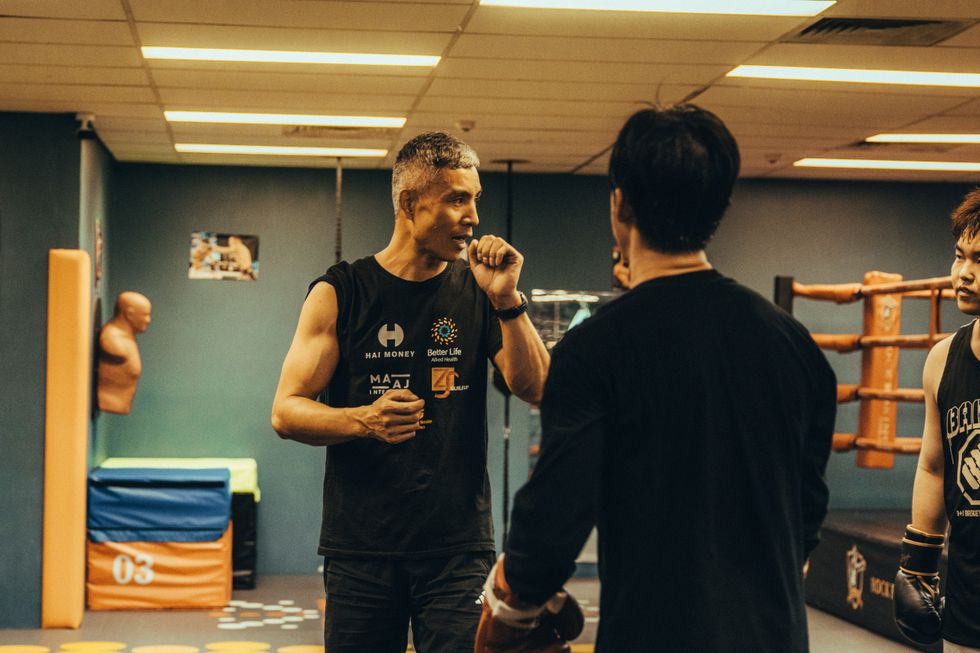 Zhang's friend says his knowledge could bring his community together.Photography: Enzo Zhang
Wenlin Xue, a Chinese postgraduate student, has also experienced racism in Sydney.
Earlier this year, while he was working part-time as a food delivery rider, he was harassed twice within a few hours.
At a pedestrian crossing, a teenager shouted a racial insult at him. A few hours later, he was hit by objects thrown by two other teenagers while riding across the road in Haymarket.
"It hit me and it was quite painful," he says. "Almost every week, I encounter this at least two or three times."
He did not report the incident.
"I feel that reporting this kind of incident to the police is difficult," he says.
"I didn’t have any evidence because everything happened very quickly and I had no time to record anything."
After the Eastgardens incident, Sydney-based programmer Robert Wang created StandTogether, a community-run website where people can report incidents of alleged youth violence and harassment, and view them on a map and timeline.
"The website has already recorded 48 youth violence incidents targeting Chinese people in Sydney," Wang says.
Since then, the number has continued to grow. At the time of publication, the site’s timeline listed 65 reports from Sydney and several other cities.
And, while these records cannot replace official statistics, they reflect issues that haven’t been addressed.
Beyond blame
Rock Zhang believes that what Chinese people experience cannot be fully attributed to society and the government. There are some things that the Chinese community should also consider.
"The Eastgardens incident is a wake-up call for all Chinese who live in Australia," he says.
In traditional Chinese culture, tolerance holds value. But Zhang believes that this shouldn’t be used incorrectly.
"We cannot lose dignity just because we are afraid of trouble," he says.
Ten days after the Eastgardens incident, Zhang organised a free self-defense class for Chinese people in Australia, where he taught boxing techniques.
"As long as they have trained, even once, even if we only do demonstrations or simulated practice, it will be helpful," he says. "Even if we can only influence one person, we feel it is worth it."
During the session, in addition to technical instruction, Zhang gave a speech.
"Chinese people should unite more and help each other," he said at the time.
"Chinese people should not hide when something happens ... At the very least, we should dare to speak up."
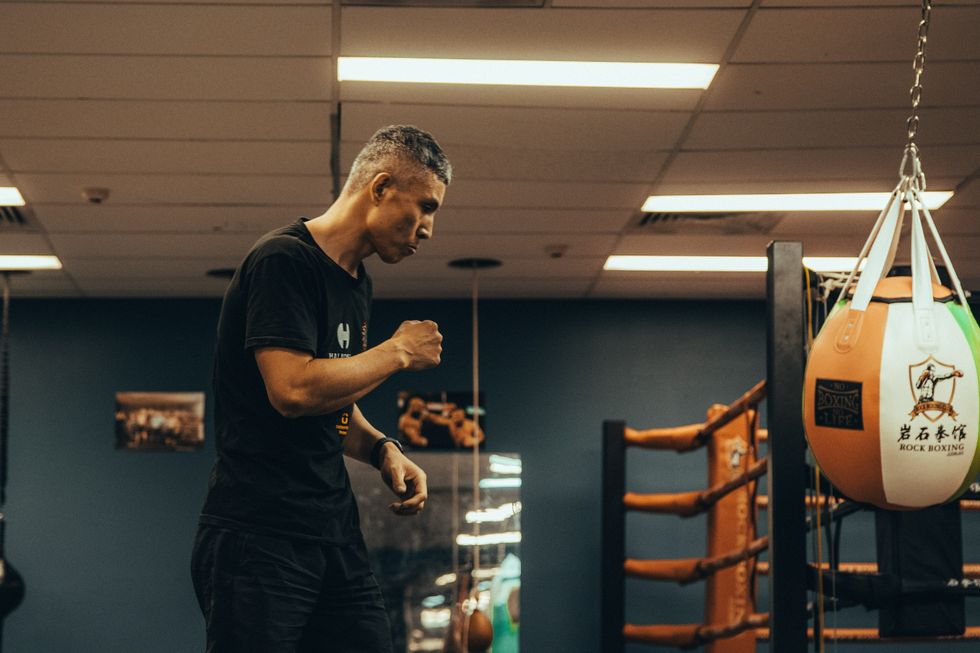 Zhang would like Chinese Australians to feel safer and more confident.Photography: Enzo Zhang
However, the experience of organising this class helped him realise some deeper problems.
"Every time something like this happens, people will come to learn boxing, but once the attention fades, they return to their previous state and stop training," he says.
"I think people need to have a firm goal, either in training or in life."
This is one of the reasons why Zhang continues to compete.
"I persist because I want to set an example," he says.
"I want to pass on the spirit of perseverance and fearlessness in the face of challenges through boxing, and to improve the sense of identity of Chinese people overseas."
Promoting change through action
Hanbiao Liu, a committee member of the Sydney Chinese Boxing Association, has known Zhang for many years and speaks highly of his friend.
"He can unify knowledge and action," Liu says.
"He proves himself through action, and influences people around him through action. He is a do-er."
Liu is also doing what he can. The 55-year-old insists on boxing training. Although his age no longer allows him to compete, his persistence continues to influence those around him.
"Speaking through action is the most meaningful thing. If I can inspire others, that is my greatest contribution," Liu says.
Having lived in Sydney for 30 years, Liu believes that youth violence is a wider, long-term issue, and it is not only faced by the Chinese community.
"Other ethnic groups are also affected, and even local white people are affected," he says.
Zhang believes that in this situation, the Chinese community should learn from the spirit of boxing and respond more bravely. "When facing violence and discrimination, we must dare to speak up, and we must live with dignity," he says.
"We must step forward to speak for ourselves and set an example for society."