

How AI is shaping the skills, tone and vocabulary of those learning a second language
Last year, I used the ChatGPT chatbot for the first time to practice for internship interviews. I chose to use an AI chatbot tool because it was a convenient and accessible tool for someone like me who spontaneously wants to study for interviews at midnight.
ChatGPT offers nine different voice artefacts and the one I selected was Arbor, which has an "easygoing and versatile" tone. Even though I didn’t think the voice was easygoing and rather more serious, I loved it because it could create a serious environment.
The practices were excellent because the chatbot instantly gave me feedback and tips to make my answer more concise.
But as I practiced with it for months, I realized certain chatbot traits were starting to be reflected on my spoken English.
I was subconsciously adopting the tone, pausing the timing or using certain vocabulary, which are all illustrations of linguistic accommodation. I also noticed that my answers were starting to become less colourful because Arbor was consistent with his serious tone.
In other words, my speech was changing to match the chatbot.
It never crossed my mind that using an AI chatbot would reshape my English, which I learned as a second language when I was in Japan and in Melbourne for high school. English is a compulsory subject in Japanese schools, as we Japanese think English is a universal language that leads to global career paths and better travelling experiences.
Today we’re coevolving with AI. However, recent research shows that those who interact with AI and spend more time with those predictive language tools than real-life people could find that their language becomes more standardised and AI-like.
Those who speak English as their second language, like me, are less likely to have a solid foundation of the language, so they are likely to be more susceptible to the impacts of the large language model (LLM) structure.
And the convenience of AI as a study buddy, a conversational partner, or even as a tool to practice communications might lead to AI language becoming ingrained in everyday language.
"If AI becomes our unofficial teacher, does it teach us to sound like the machine?" asks Dr Melissa Reed.
Dr Reed is a lecturer in Applied Linguistics and TESOL (Teaching English to Speakers of Other Languages) at Macquarie University, with experience as an English language teacher.
She explains what happens when non-native English speakers learn language via AI.
"The influence of AI has absolutely 100 per cent effects, especially [in] the writing that we produce — it’s much more standardised, there’s much less variation in it," she says.
Standardised English creates a similarity in the way non-native English speakers speak.
"It is erasing a lot of individual creativity, or it becomes more unusual to see variations," Dr Reed says.
Being a native speaker doesn’t necessarily mean they perform perfect language structures. In fact, Dr Reed says it can be the opposite. "As you become a more advanced language user, you make more conscious choices about actually bending those rules."
In June 2025, researchers at Germany’s Max Planck Institute for Human Development released evidence to show that AI language is moving from written text into spoken human communication.
They used a huge dataset, drawing on 740,249 hours of YouTube academic talks and 772,591 podcast episodes.
Their analysis started with looking at the original human-authored texts that pre-existed ChatGPT. This includes arXiv abstracts (a free, open-access inventory for scientific papers), students' essays, news descriptions, and Wikipedia articles. They treated them as a pre-existing dataset and asked ChatGPT to rewrite them.
The prompts they used were:
- Prompt 1: Please polish this text: {text}
- Prompt 2: Can you improve this text:{text}
- Prompt 3: Please rephrase this text to improve its clarity: {text}
After that, they compared word frequency in the original texts and the GPT-edited versions to identify words that appeared much more frequently after the edit.
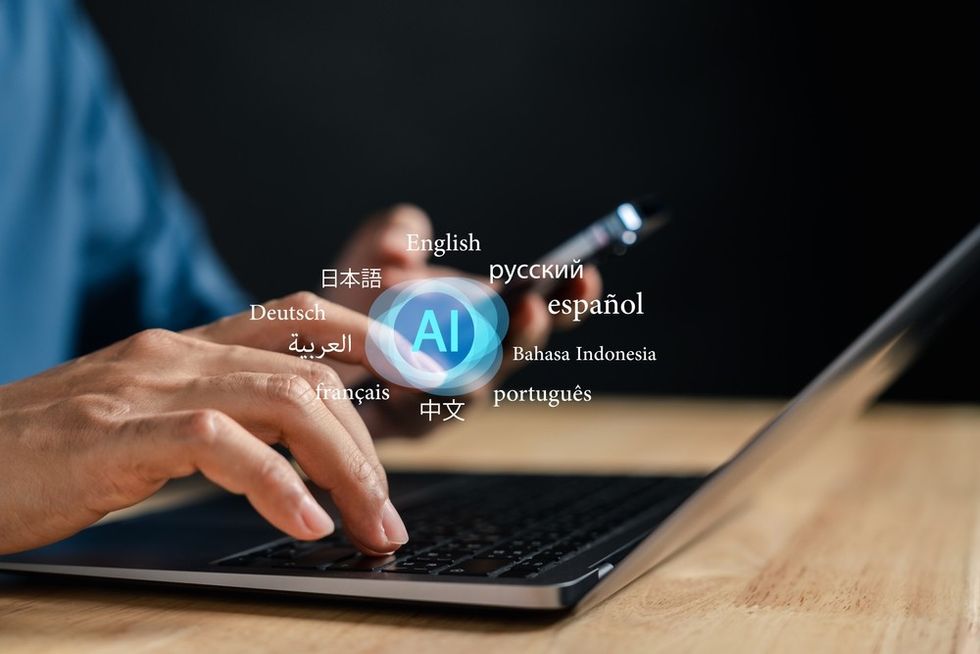 AI is having a tangible impact on our spoken language, particularly in those who learn second languages with the help of a chatbot. Shutterstock
Then, they looked at YouTube talks and podcast episodes after 30 November 2022 (ChatGPT’s release date) to examine whether those words started appearing more often in those transcripts.
The result was clear. They found that after the release of ChatGPT, people began using words like "delve", "comprehend", "swift", and "meticulous" more frequently.
These are all words that LLM frequently uses.
"These findings suggest a scenario where machines, originally trained on human data and subsequently exhibiting their own cultural traits, can, in turn, measurably reshape human culture," they reported.
However, a study released in February 2026 by researchers from the University of Jyväskylä, Finland, who looked at the effects of AI on those learning a foreign language, found something different.
The researchers looked at 51 experimental studies published between 2023 and 2025 (the first wave of research after ChatGPT’s release in 2022) and 175 independent measured results in language learning from those 51 studies.
Each result measured how much GenAI changed things, including writing ability, verbal performance, vocabulary development, anxiety reduction, self-efficacy, and related psychological factors.
The study found that GenAI not only helped students improve technical language skills such as writing, speaking and reading, but also helped with learners’ confidence, metacognitive awareness and anxiety levels.
Dr Katy Gero, a human-computer interaction researcher at the University of Sydney, says AI tools and "language models are not neutral technology objects."
She explains AI is shaped by human choices, data filtering and company decisions. ChatGPT’s English is not universal. It is a designed version of English, and "certain cultures are overrepresented." Instead, people may use certain words because they "don’t want to sound AI-generated."
And, as she points out, being accused of AI use for creative writing can become a "big insult" these days.
"We’re kind of antagonistically moving away from an AI language to indicate our humanness," she says.
Learning a second language is not an easy process and takes years to master. "If you want to do something really interesting or really unique, just start from scratch," she says.
There’s something else to consider. According to research published in 2025, while the use of LLMs could potentially enhance individual creativity, the collective diversity of creative ideas could be reduced.
Georgetown researchers Kibum Moon, Adam E Green and Kostadin Kushely looked at more than 20,000 college admission essays and concluded that human writing increased the variety of ideas across a group of essays more than ChatGPT generated essays. And interestingly, they found that a human-written essay "contributes more new ideas than a GPT-generated essay".
For me, AI has helped me sound sharper and more professional in both English writing and speaking. For that reason, I am grateful, but I also wonder what parts of my English have been shaped or modified by AI and how much still comes from mistakes, friendships, classrooms, relationships, and conversations with people in real life.
For non-native English speakers, Al may open doors that language learning has long kept closed. Their English is likely to be much cleaner and more polished.
However, I wonder whether the English we’re learning still sounds like us.
Language is not just the combination of vocabulary, grammar, and sentence structures; it captures cultures, personality, humanity, communal values, and linguistic vulnerability.
And that’s why I’m going back to practicing with my friends.